Review on Scott Roche Reviews
Audio drama critic Scott Roche reviews The Mask of Inanna on his website.
He reviews many other audio works on his site too – check it out!
Comments: Leave a Comment
Review on Scott Roche ReviewsAudio drama critic Scott Roche reviews The Mask of Inanna on his website. He reviews many other audio works on his site too – check it out! Comments: Leave a Comment
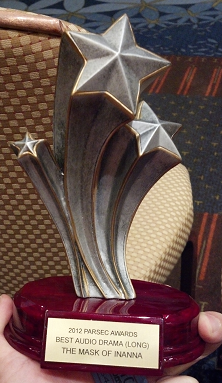
“The Mask of Inanna” – 2012 Parsec Award Winner
It’s official! Announced at Dragon*Con… The Mask of Inanna has won the 2012 Parsec Award for the Best Speculative Fiction Audio Drama (Long Form) category (initial announcement). For those who don’t know, the Parsec Awards are one of the most prestigious audio drama awards out there. Julia Lunetta picked up the award for me (shown to the right). I’m just speechless right now. We were up against some tough competition who all deserved the award as much as we did. (I recommend checking out Second Shift which is awesome and stars a lot of the same cast I had.) Thanks to everybody for the love and support we got. Here’s a link to my acceptance speech, which Julia read at the ceremony. Listen to audio of Julia Lunetta and Brad Smith getting the award and giving the speech here (2.5MB MP3) – original source.
Comments: 2 Comments
Review on Radio Drama Reviews OnlineAudio drama critic Lawrence Raw reviews The Mask of Inanna on his website. He reviews many other audio works on his site too – check it out! Comments: Leave a Comment
Back on Radio Drama Revival!Season 2, Episodes 1 and 2 are being released on Fred Greenhalgh’s Radio Drama Revival podcast! Link to Season 2, Episode 1, “Glory Days”. Link to Season 2, Episode 2, “Smoking Monkey”. (Coming next week) Comments: Leave a Comment
Interview With Arlene RadaskyArlene Radasky, author of The Fox, interviews Alicia E. Goranson, writer/director/producer/editor of The Mask of Inanna about the show on the Raise a Racket podcast. Hey, it’s 2024 Alicia and this link is dead! Boooooo. I am sad now. It was a fun interview – enjoy! Comments: 1 Comment
Show Notes for Season 2, Episode 4 “Apocalypse”You learn a lot about yourself when working on a project at the scale of Mask of Inanna. I learned that, while I dream of ending a story just by stopping after a particular memorable and character-changing event, letting the ramifications just sit with the reader, I can’t do it. I tried it with “The B’Arkies”, which was mostly plotted and had a “kinda-ending”, and while the work I did on it was hugely satisfying, I just couldn’t finish it because the OCD parts of my brain demanded that I tie up all the character arcs and plot threads in a neat little bow. “Do this or I will haunt you as the specter of unfinished work,” this part of my brain said. This is why Apocalypse ends all tied up in a neat little bow. If you can’t tell, this was originally two episodes that I mashed together, mostly because script editor Vicki Bloom told me, in nicer words, “Get on with it!” The original So2E04 was called “A Horror of Rooms” and was a musical. It would have featured Jessie and Chris trapped in the Other Side of the Lighthouse, facing four singing demons, each representing an iconic horror character from the subsequent decades after the 1950’s, and would include:
I got through 3/4 of Groovy Devil’s song when I realized that I didn’t have the musical chops to pull off three more of these, and dropped the idea. “A Horror of Rooms” then became more of a story about Jessie and David putting away the Prayer and going back to their normal lives. Jessie’s original teacher, a spirit Fox based on Sitting Ghost in Maxine Hong Kingston’s book Woman Warrior, returns. Jessie first met Fox when she went into the abandoned After Dark studio in the 1950s, which was magically charged and thus the perfect home for Fox. In the present day, Fox asks Jessie to remember all she taught her, and in return, to clear out the lighthouse spirits so that Fox could live in the lighthouse as she had done in the studio. Jessie creates some spiritual constructs based on Rocky Horror, Friday the 13th and Manos, Hands of Fate to clear out the place, and sets them lose. Then, Chris shows up, pretty much as he does in Apocalypse, and he joins Jessie in bringing the mask back to the lighthouse. They fight Fox and the three constructs, and the final result is pretty much like the result of the Beetle fight in Apocalypse. It ended in Allen’s return. All in all, I kept about a third of “Horror of Rooms“, but I had to junk the whole “loving-tribute-to-where-horror-went-in-the-subsequent-decades” angle. The introduction to this episode, which recounts all the major plot points backwards, brings the listener back in time to the very start of After Dark, where we learn how Allen was brought on board and how Bob Stroud was tempted to the dark side. This was inspired by the beginning of the final Season 5 episode of Buffy the Vampire Slayer, which presented the series’ plot points in chronological order. It does this much faster with increasingly short jump cuts until each plot point is barely a few frames – but you can’t get away with this in audio if you want the listeners to understand. We can recall a memory and its context from just one frame of visual data, but for audio, unless I had a unique and memorable sound for all the plot points, that wasn’t going to happen. When first offered the After Dark job, Allen turns it down, as is the tradition of the epic hero – the refusal of the call. I wasn’t following Campbell directly (bleh), but I’ve always thought that the refusal part is a good way to de-trope your character and give them a chance to assert themselves over the story for a bit. Mr. Keen, Tracer of Lost Persons is a real show that would have ended about the time Allen was set to direct – so it’s a good thing he didn’t take the job! I had to include the bar scene because I wanted the listeners to revisit the early, uncomplicated days of After Dark, when it was just a bunch of friends having fun on a show. I needed to establish that in order to contrast how far they fell from that ideal in the subsequent years when everything went to hell. Bob Stroud is tempted to go to Hollywood by Wynken and Blynken of Wynken, Blynken, and Nod fame. I was actually referring to them in their “gas-mask-wearing tricycle-riding villains” incarnation from the comic Doom Patrol. The repeated scene from S01E01 in which Bob Stroud leaves actually has all new sound effects. Christ, the SFX were spartan in S01E01 and S01E02. I can’t believe I ever let those shows out with as few SFX as they have. (No, I’m not going to George Lucas them unless I can make a crapload of money from merchandising.) Bob Stroud confronting the Speed Bump one last time was the last bit that James Scheffler recorded in Jan. 2011 before returning to the Marines and Afghanistan, and his voice was almost shredded to nothing by that point in the afternoon. We were incredibly lucky that he stayed on to record this bit. (By the way, he came back in January 2012, yay!) The After Dark ending bit that Lewis reads is from one of the cut “After Dark” episodes, called “The Colorful Man”. That was actually the second After Dark I wrote, originally for S02E02. It has its moments but overall, I’m glad we cut it. Even after I had a S02E04 script in 2010, I still did a ton of re-writes on entire scenes before we recorded them, and the scene with Chris, Scottie and Jessie in the tunnel went through a couple iterations before I got the balance right between the characters. The Beetle sequence was a shortened re-write of the original Fox climax sequence, with the Beetle being an entirely different character. Originally, I planned to have more spirits shouting things like “Rah rah sis boom bah” and other similar sports-crowd noises – we actually recorded this. But it lightened the mood too much when I tried it so I axed the crowd. I was actually surprised how creepy the Beetle came out after I added all the effects – sometimes you never know what you’re going to get when you brew these little alchemical scenes! If you’ve read my book Provincetown, Ho!, you’ll know there’s a similar scene in there. Yes, I steal from myself. I’m not ashamed. Yes, that’s me as the rude customer. I didn’t plan that – our actor for the role dropped out and I had to fill in at the last minute. Andy Lebrun (Allen) ran the recording equipment and can tell you how many takes of myself I recorded because I am a stickler and a perfectionist 😛 Yes, and Scottie has her tuning fork exactly where Wolverine has his claws. This was not only intentional, but planned from the very start. Yes, I do populate this show with comic book references – why do you ask? I originally had Allen have two visions of the soldiers in Iraq but I cut one for pacing purposes. Most of the major plot points of the ending were planned out before I’d even written the first episode, including setting the car on fire while Allen was on the phone to the dispatchers. The scenes between Chris and Scottie were recorded asynchronously as their schedules didn’t overlap. Brad Smith (Chris) was talking to me (though probably imagining he was talking to Mindy Klenoff) while Nellie Farrington (Scottie) was talking to Andy Lebrun. I was very impressed how well it came out – you can’t tell that they aren’t really talking to one another. David Lewis can’t hear the Beetle because of his sin of Pride and because he views magic as a resource, not as something innately present in all things with various opinions of its own. You notice he suffers a distinctly ironic punishment for that – if he believes that magic is only a resource, then here’s some “resource” for the fire for him. When he is asked, “Do you want to save us? Or do you want us to be saved?,” he answers what makes sense to his driven, focused point of view. I want to save you, and on my terms. Wrong answer, bub. When we are in service to a deity, it’s vitally important to listen to what they have to say and to put aside one’s own pride and modesty for the sake of what we received. (Yes, a lot of this is a reflection on my own service time, which it is not my place to discuss here.) The Golden Rescue of Sinbad, as with any other After Darks, was born from Turner Classic Movies, specifically The Golden Voyage of Sinbad which is notable as the villain is Tom Baker, the fourth and most popular Doctor Who. In fact, this movie convinced the Dr. Who producers that he was qualified for the job. It’s just… interesting to see him as the villain. Anyhow, I’ve always loved the Scheherazade tales growing up – they were pretty much the big budget spectacles of their day. Jamilah is actually Sinbad’s canon wife who he meets in his seventh voyage, although she is not named in that story. (BTW – the bird-men in that story being devils, from a writer’s POV, is a complete ass-pull from someone who had no idea where the story was going and was obviously making it up as they went along.) Anyhow, you’ll notice John Deschene from “I Was a Communist for the CIA” is back! And I love him for it. And Jenny Gutbezahl gives her final performance as Jamilah. Ah, swoon. Also, I had to speed their lines up about 20% for reasons I’ve stated before – lines delivered on stage are reaaaaallllyyyy sllloowwwww in the context of an action adventure serial. Anyhow, the lands mentioned in this After Dark episode are references to other shows. The first land of Terrakhan is a reference to PMRP’s other live show/audio drama “Red Shift” and it’s episode “The Terror of Terror-Khan“. The second and third lands, Meeharkhan and Tzahnapurek respectively, are references to the other show who shares most of the same actors, “Second Shift”. “Meeharkhan” is a combination of the way that the society pronounces Mike Archer‘s first name as “Meek”, and Julia Lunetta’s character “Arkahn“. “Tzahnapurek ” is combination of the character “Zana” and Neil Marsh’s character “Porec”. Back in the real world, I continue my lack of subtlety by having David Lewis see better with his eyes closed (o\~ Smoke gets in your eeeyyyeeeess… ~\o), supported by a pillar of smoke. We’re going full-on symbolic here. You might not have noticed, but your brain did. He’s now a full-on earth and air-bender who is brought to a standstill by a fire and water-bender. I don’t know what it’ll take you to believe me when I say that I never saw or had heard of the Nickelodeon show when I wrote this episode in 2009, but I will admit that I played a lot of Final Fantasy. Also, regarding this episode’s After Dark show, I wonder what classic myth it’s retelling. This is where the Dance of the Seven Veils comes from – and you’re lucky I didn’t throw any Salome references in there too. Because with any “head of John the Baptist” references, I’d have to add references to C.S. Lewis’ “That Hideous Strength” and then to Grant Morrison’s “The Invisibles” who I’ll avoid any notes about the final confrontation, but suffice it to say, it took a lot of balancing for Lewis to have not come out as the bad guy in it. The final goodbye scene was completely scrapped and re-written four times, although the final line of the show remains the same in every draft. I only thought of it when I was writing the first draft, and I thought it was a great little tug on that pretty bow on which the show ends. Do not expect this from me in future shows – I will gladly slaughter my future casts if the show demands it. This show didn’t. If you’ve read this far, you’re an incredible listener and I thank you for your generous time and attention to our little show. We simply couldn’t do this without folks like you enjoying the work we do. Thank you so much. Whether or not you feel it, you helped make this happen. You are so awesome 🙂 Comments: Leave a Comment
Th’ Marsk o’ InannaWhen Neil and I were getting ready to record the first episode of MoI in 2010, I propositioned a possible spinoff – a pirate-theme show called “Th’ Marsk o’ Inanna”. It went something like this:
LEN: Aye, me swashbucklin’ days be over. My fair wench Gwen be in the clutches o’ Davie Jones, and I be at th’ ol’ Buccaneer’s home. (Then they sail off and kidnap a ship for a reason I can’t remember.) (And then Len tells an alternate version of “By the Brake Lights’ Red Glare“) (And then Bob Stroud attacks their vessel.) STROUD: Not so fast! I be takin’ the old man fer meself. And not in that way! Take yer heads outta th’ gutters and fill ’em with grog!
Yeah, that’s as far as I got. Comments: Leave a Comment
Show Notes for Season 2, Episode 3 “The Black Velvet Ribbon”I frikkin’ loved getting to the point at which I could write this episode. I’d been building up to it for the past seven and finally, the audience gets some fantastic pay-off after listening to plot points introduced in the admittedly less-than-stellar first 3/4 of S01E02. The title comes from the old story that most middle-schoolers in the States have to read. A man marries a woman with a black velvet ribbon around her neck, who cannot take it off – for reasons very similar to the reasons that a certain character in this episode is unable to remove a similar chain. Very Halloweeny. This title didn’t come to me until the episode was written, as you’ll see why below. The plane ride wasn’t intended to be a callback to Shatner’s greatest moment on the Twilight Zone. The purpose was, Len and Scottie needed to be in an enclosed space, and I needed to establish/foreshadow the true horror of the Big Bads of the episode, specifically their power: “It also poses a danger if allowed into a room with a fresh corpse; a [Big Bad] is believed to be capable of reanimating a body by jumping over it.” The inspiration for the Big Bads, as with most other things in my life, is in fact the Shin Megami Tensei series. I have been trying to get Shin Megami Tensei demons in everything I’ve done with PMRP and Neil, to my constant frustration, keeps taking them out. (For example, I had Decarabia in The Sirens of War in PMRP’s 2010 Tomes of Terror show, but Neil and Jess took him out.) So, we start with the airplane scene to establish with the Big Bads can do with the chicken meat, and to teach the listener to expect a lot more “Uth, uth uthing” in the future. The next scene, Dot’s back. Come on, if you’re going into the supervillain’s lair, you have to meet The Dragon again, particularly if you never saw her die. I wanted each of the churches to have their own type of demons, and I thought that the Mammons would want some mind-control ones. The fight-or-flight response is bred into us so having the demons tap into that was the natural course of action. Naturally, Huginn and Muninn couldn’t speak directly (what creature from other world could?) so they speak in mashed XTC lyrics. Have I mentioned that XTC is my favorite musical group in all of existence? That I’m a tremendous fan of Andy Partridge‘s works? Listen to this and tell me you don’t feel smarter and better off from having heard it afterwards. Anyhow, unless you’ve listened to their catalog dozens of times, you won’t figure out which songs each of these mashed up lyrics come from. I was waiting to do the reuniting scene with Bob Stroud for a long time, although not as long as you might think 🙂 James Scheffler had announced he was returning to military service in January 2010, before we have released S01E05, and so I was like, ohshitohshitwehavetorecordallyourstuffnow. So James braved through a marathon six hour recording session to record everything in S02E03 and S02E04 at once. He had a cold and by the end of the afternoon he had no voice left. Please be upstanding for the bravery and tenacity of James. He did an incredible job because, he doesn’t sound like an old guy. He sounds like a young guy doing an old guy’s voice. And yet he completely pulls it off. He sounds every bit as jaded and burnt as I envisioned Stroud at that point. Also, for all you budding radio drama engineers out there, quiet scenes like these are just as hard to program as more complex ones. You have to add the physicality of the presence of the voices in your quiet scenes. Sure, I could have had all of the characters as talking heads, but I added their footsteps, the rustling of their clothes, their shifting on the leather couches, all put in at such natural points that the listener doesn’t hear them – tunes them out. You add so much to a scene by doing this, and as you probably know already, it’s very hard work to make scene elements so natural that the audience won’t notice them at all. (Also fyi – the scene fragments with Dot/Jennifer Pelland were recorded months later, but they integrated great so you can’t tell.) Anyhow, they go back to Bob and he can’t help them. If you’ve read my novel Provincetown, Ho!, you’ll notice that this is a familiar theme in my work. I could have sworn that I was influenced by this theme from a Steinbeck novel in which a boy who grew up with only his mother goes on a long trip to find his father, and then meets him in a pool hall, all expectant to finally be able to bond with him, only to find that his dad is a selfish bastard who asks him if his mother sent him over for her alimony. I could have sworn it was East of Eden but the internet is telling me otherwise. No idea what book it is then. Ah, The Shivers of Highway ’61. Yes, I was watching TCM and yes, Marlon Brando’s “The Wild One” was on. I am really a simple soul. I hope you enjoyed “The Rolling Stones” joke as “The Wild One” spawned The Beatles. Also, a bit of Rosie and Pig’s dialog was improvised by Mike and Jenny. I had to keep it in 🙂 After that, we have a scene in which Dot has a moment of intimacy with Scottie. I wanted Scottie to understand how well someone can get under her skin and how out-of-her-league she was. I often feel that way myself, being functionally developmentally younger than my actual age (as is the case with most autistic-spectrum people). That’s why we connect with animals so much, like Temple Grandin – we’re not as “developmentally mature” as you all are. So, off Len and Scottie go when the Big Bads attacked. The whole “Focus, Pray Offer” schtick was created when I was writing these set of scenes. I needed for Len to be able to get a one-up on the Big Bads and I had to have established it in earlier episodes. So I had to go back through all the episodes in which Len interacts with the Big Bads and add the whole “Focus Pray Offer” schtick. Sorry about that. Had to do it. Didn’t want to. Boss told me to. The scene in the liquor took me a month to do. I’m not kidding – it’s about 25 tracks and everything in hand-placed. At first, the puppet’s footsteps were sounding off so I had to move each one in relation to their grunts. I had to go through all the actors’ grunts and sort them and pick only the best. This was a very tedious scene to do. Julia and Kerri sang the minor-key Alouette on the spot, way back in 2009 when they were first cast. I’m very proud of their work. Andy (Len), whose voice work is so spot-on that I generally don’t mention it here (what was that I was saying about work so good that you don’t notice it?), had some confusion about how to do this scene initially. He did the initial takes playing the lines for laughs, and I had to keep telling him, no, this was a serious and scary scene. He replied that the lines were funny, which they are in one context but not in this one. Len had been hit in the head, had significant blood loss, and was in full-on insane-prophet mode. After the first take, Andy asked me to explain exactly what I wanted, and I said, in this scene Len is entirely hindbrain. He’s saying the first thing that comes to his head. He’s not entirely in control until something happens that brings him around. (And Andy did fantastic once he started thinking like that.) With regards to the something that happens (no spoilers), I wasn’t planning it. Just when I was writing that scene, thinking about the Big Bads’ motivations, I couldn’t think of a single reason why they wouldn’t do what they did. So they did it. And it turned out to fit very well, thematically. Comments: Leave a Comment
Show Notes for Season 2, Episode 2 “Smoking Monkey”If there ever was an episode which had to exist for narrative structure, this would be it. In development, I often wished I could have moved Allen and Scottie from Point A to Point B in one scene at the end of Season 2, Episode 1, but alas, it was not to be. Also, I had a lot of setup to do for the final episode in this one. So, the intro scene in which Chris shows up again… the original Season 1 Episode 5 was called “Red Roses for a Blue Scottie” and was cut for various reasons (we weren’t sure we were going to make it that far and making the episodes was a lot of work and that one could be safely cut). However, it introduced two big point points that I had to shoehorn in other episodes. One plot point went into Season 1 Episode 2, and the other went into this intro scene. It was done much cooler in the original “Red Roses”, but hey, we work with what we have. The scene with David Lewis reading Nicolette’s letter – I was originally going to have Nicolette doing work in Team Lioness in Iraq, but the rest of the cast pushed me to keep Nicolette on base. (That’s why we have all that “you know how many soldiers are killed from IEDs hurled over the walls” lines – originally I wanted Nicolette out and about, but they didn’t understand Lioness and I was tired of having to justify it.) Anyhow, I was originally going to have an actor playing Nicolette reading it, but then I realized that that would be too distracting from the emotional intensity of the scene. Plus Doug has a fantastic voice and who am I to deny our listeners from hearing it? Next scene, Scottie: “Everything closes at nine. Nobody‘s supposed to have a life.” HI, POCASSET, VILLAGE IN WHICH I GREW UP. NO, NO, THIS ISN’T A COMMENTARY ON YOU IN ANY WAY. (During Thanksgiving, I commented to my sister, if any European folks had come to stay in Pocasset, they’d be all, “So, where’s the bus?”) I loved “hearing” the scene in which Allen tests the Speed Bump’s teleporting techniques by trying to steal a boat when I wrote it. I know exactly which dock he’s going to in Pocasset to take it. And the “Smoking Monkey” story. I generally put on Turner Classic Movies when I’m editing (with the sound off) for inspiration and they regularly play “Mutiny on the Bounty.” So I needed Allen to tell Scottie a story here and I didn’t quite have it until I heard someone on NPR talking about how they used to make chimps smoke cigarettes for films. (And if you were ever a part of this, screw you and I hope they relegate you to the special part of hell run by Jane Goodall.) So the story came naturally after those influences. Being a writer is less about what you can come up with out of the blue and more about how you can pick apart things to which you’ve been exposed and reform them in entertaining ways. Allen vs. Lewis – this was the main crux of the episode and I wish I’d have been able to do more with that. Allen purposefully getting wasted (set up in Season 1 Episode 2) was a plan for a long time. Originally, instead of the Long Walk, Allen and company went on a camping trip (during which said enclosure was built around the lighthouse). It…. uh…. had to be re-written. It had some good moments but just moved the action away and felt more like “okay, let’s kill time until the next plot point.” The “twist ending” isn’t really a twist – if you listen to the show again, you’ll hear that I put hints of it throughout the show. Finally, the minisode itself was originally written to be performed live for PMRP’s New Year’s Eve performance in 2009. Neil decided that there wasn’t time to do an original piece so they did an episode from Rob Noyes’ Red Shift show. I don’t know – I was kinda proud that I’d thought up the concept of a Noir-esque show about Boston’s ice industry, with an “I’ll show them – I’ll show them all!” performed without irony at the show’s crux. By the way, you should really check out Rob’s fantastic blog “Postcards from Skyrim“. Comments: Leave a Comment
Show Notes for Season 2 Episode 1 “Glory Days”This was the hardest episode I ever had to put together. I started working on it in March and finished it on the day of release. I had only given myself February off to recuperate from the grueling pace of production on the first season. In retrospect, I needed more time off but then again, you would have had to wait even longer for the new season. So, three things happened:
So “Glory Days” took me three months to do. It’s lonely work, doing all this editing myself without anyone to bounce ideas off of. When I had finally cut a draft together the week before the release date, I took it on the standard car-radio-test – and I was really disappointed. It lacked energy. Conversations would shift in tone, dramatically. I know it was in trouble even during production – I actually had Leslie come back and record a ton of Gwen’s lines. (Neil was kind enough to speed up the Fanbeings’ lines for me since Audition was introducing too many artifacts.) So I spent that Thursday through Saturday painstakingly recutting the episode together from scratch. The original Audition file has all the tracks in nice clean strips. The reworked file looks like a crocodile’s skin – the tracks were sliced up in a very fine manner and a lot of the key special effects were redone. Okay, onto the episode itself. “Glory Days” = Bruce Springsteen, etc. etc. Now you know what the Mouse and the cats were talking about in Season 1 when they said, “She’s going to be very mad, you know.” We were originally going to include that line in Season 1 Episode 1 but we weren’t sure we would make it through that season. The reveal had to be organic – so I had to give Len something that he would feel as passionately nostalgic about as Inanna would. So Gwen returns, as foreshadowed in Season 1 Episode 2. Leslie was cast as Gwen back in 2008, I think, but it took us a while to get around to her. Sorry about that! (Andy was also cast as Len before Neil had come to me with the project. Fancy that.) This episode is about the feelings I got when I dreamed about my mother being alive. She died in 2008 from breast cancer and I wrote this episode shortly after that. Gwen isn’t an analogue for my mother – this was more about the feelings I had about seeing a dead person alive again. Also, being a post-humanist furry with Asperger’s syndrome, I was very happy to be able to write a story about an interspecies romance in which the participants actively fight to make the relationship work. The “June Comes Around Every Year” leitmotif was a lucky accident. I knew I needed a leitmotif so I went to my volume of public domain jazz and that ws one of the first tracks I heard at random. The initial scene with Allen and Gwen meeting for the first time is my favorite scene in the whole show. (Well, actually second favorite, but my favorite is in one of the scripts we won’t produce, in which a young David Lewis chases after a young Jessie while she’s trying to buy weed.) I really love the tender character establishment that happens over only two pages of script. Andy and Leslie pulled it off amazingly well. That scene was originally smooshed in the middle of the episode – a flashback happening on the lighthouse cliffside – but it was too good for that spot. And it sells you on the romance early in the episode. The church dinner at the beginning – that’s only four people doing the congregation’s voices, believe it or not. There’s a lot of audio trickery that took a while to do to make it sound like tens of people. I love the scene in which Len and Gwen break up, too. My Presonus audio board died during the recording of this scene so I missed out on recording a hilarious take that Andy and Leslie did, doing the scene as a comedy bit. So, did any of you pick up in Season 1, Episode 1, that David Lewis says he’s from the Harper Foundation, and that Scottie introduces herself as Sara Harper in that exact same episode? Or did you only realize it when David says it in this episode? The “charms” special effect is a set of windchimes I have, nestled in a sweater, and spun around in my bedroom until I was sick and nauseous – multiple times, and then with the takes overlayed. The things I do for you guys. The scene on the lighthouse cliffside had a good quarter of the dialogue chopped out of it to make it work. But thank goodness… I got it to work. That scene just wasn’t working for so long, I didn’t know what I was going to do. The Mouse flipping the lighthouse – well, heck, I had already established the “two worlds” concept – what kind of post-modern author would I be if I didn’t actively flip it around? Basically, it’s like a fish wanting to talk to you so it floods your house. I had to do the Fanbeings. The script compelled me – because there’s a reason for the Fanbeings which we won’t get to until the last episode. The minisode, “The Never People” is based on what I thought the average 1950’s suburbanite would think of our modern economic system. In the 1950’s, you almost never saw a bank in a strip mall – that was almost like crossing a line. Offering money and credit right next to the places you’d go and spend it? That’s just… unseemly and unwholesome and oh god where can I sign up? But wait – where’s the money going to come from? You’re not mortgaging your children’s future just for a few extra baubles today? Oh god, you are! I knew it! (Also, damn, that’s a nice television you future people have – how did you get it to be so flat?) So, yes, “The Never People” is kind of a Twilight Zone conspiracy theory about the future. After Gwen gets defaced (and seriously, what did she expect would happen when she grabbed two squirmy kitties with great big claws?) that’s me as the scratchy voice that underlays Leslie’s lines. I recorded lots of takes and even then I had to rechop them to match Leslie’s lines. It was a fairly horrible experience, particularly to my throat, and I’d rather not do it again. The ending – I definitely wanted to leave the audience with that dichotomy – the big reveal doesn’t matter next to Len’s sadness. I’m fairly happy with the end result. Thanks to Andy and all the actors that made the considerable effort to get this episode done. Comments: Leave a Comment
|
iTunes FeedHelp Fund our Next ProjectOther ProjectsArchives
The AffiliatedCategories |